

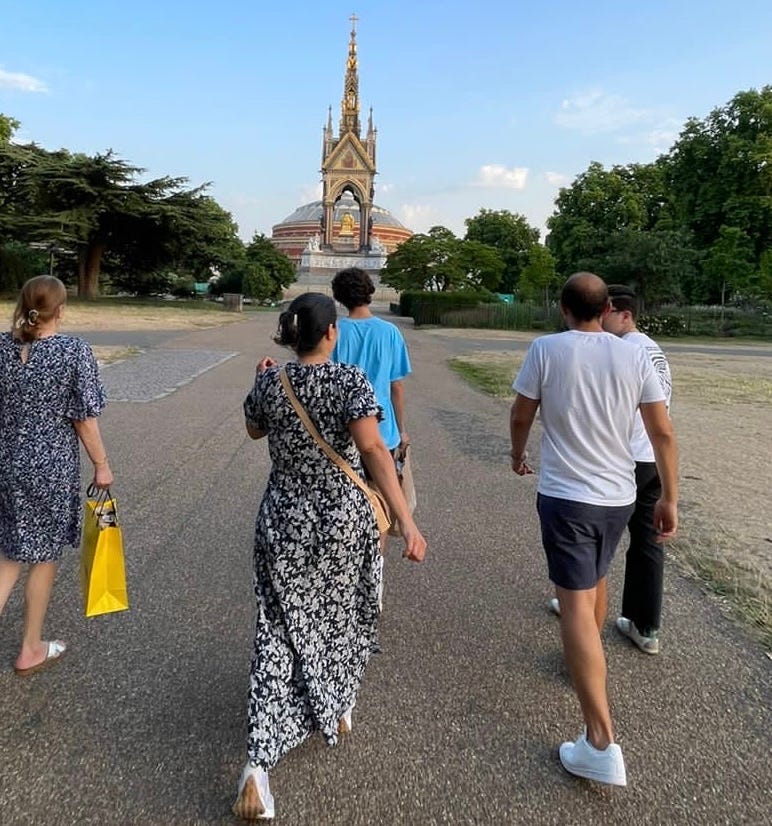
I love my birthday, and I make sure everyone knows it. I love the ceremony of it. I love feeling celebrated. In our family, birthdays are never just birthdays. They’re birthday weeks. Everyone knows this about me. They all think it’s ridiculous. But they humor me anyway:)
Sometimes Birthday Week starts early. Sometimes it spills into the following week. It depends where we are, who’s in town, and whether I can persuade everyone that birthdays should really last longer than twenty-four hours. And why not? August practically invites it. Everyone is off school, everything slows down, and suddenly there’s time for coffee mornings, afternoon teas, lunches, dinners—sometimes all in the same day. Then we usually gather for a proper family celebration with a big BBQ or brunch and, obviously, lots of cake.
This year, though, I wanted something simpler. Just lunch with my husband, my kids, and my daughter’s fiancé (yes...I’m the Mother of the Bride again 😉). My other daughter was back in Tokyo with her husband and my grandson, and I missed them terribly. Such is life. Children grow up. They fall in love. They build lives of their own.
And somewhere in the middle of all that, I turned fifty-three.
I have to admit, I’m still negotiating with the number. Fifty-three doesn’t offend me exactly, but it does surprise me every time I say it out loud. It feels larger than the life I’m currently living. Not because I resent getting older; I don’t. But because somewhere in my mind, fifty-three belonged to grown-ups. Proper grown-ups. The kind who had reading glasses hanging around their necks and a collection of medications in the kitchen cupboard.
Fifty-three is not a small number. It isn’t old in the way eighty-three is old, but it isn’t one of those cheerful little numbers either. It makes you mentally leap ahead. Fifty-three somehow carries sixty-three inside it. And seventy-three. And, if we’re honest, the end. That’s what numbers do once you cross fifty. They stop arriving one at a time and start traveling in groups.
I remember my parents at fifty-three. They felt unquestionably older than I do now. By then they’d accumulated diagnoses, surgeries and medications in a way that seemed perfectly ordinary because everyone around them was doing the same.
Diabetes had arrived. High blood pressure had arrived. There had been a slipped disc, a hysterectomy, a gallbladder removal. None of it felt remarkable. It simply seemed to be what happened once people reached their fifties.
And yet here I am, occupying exactly the same number while feeling like someone else entirely. The woman inside my head is still about forty-three. She has a few more grey hairs now and a couple of lines around her eyes that weren’t there before, but otherwise she hasn’t changed very much. She still wants to book trips on a whim, make plans ten years into the future, spend an entire day wandering through a new city before staying out late for dinner. She certainly hasn’t received the memo that she’s apparently fifty-three.
Maybe that’s why I laughed when I read somewhere that Generation X is going to become the greatest generation of grandmothers in history.
I thought, of course we are.
We’re the generation that watched the women before us spend the last decade or two of their lives sitting on the sidelines, not necessarily because they wanted to, but because declining health was presented to them as simply what happened when you got older. We watched it. We worried about it. And then we inherited a very different world: more information, more examples, more access to knowledge, more possibilities.
We don’t have to inherit our mothers’ health simply because we inherited their genes.
Not everyone will choose a different path, of course. But many of us can. And I find that incredibly hopeful.
Perhaps that’s what feels so strange about fifty-three. Not aging itself, but the growing realization that my body and my calendar are telling two completely different stories. The calendar insists I’m moving steadily down the mountain. My body keeps lacing up its walking shoes and asking where we’re going next.
Since I can’t negotiate with the calendar, I’ve found something else to measure instead.
Every birthday now begins the same way. Before anyone sings, before the candles are lit, I sit with a notebook and ask myself the same questions I’ve been asking for years.
They aren’t the questions you’ll find on a blood test or in a doctor’s office.
They’re much simpler: They ask whether my body still lets me participate in the life I want to live.
Can I still climb several flights of stairs without thinking about it? Could I spend an entire day wandering through a city I love? Would my body let me book a flight tomorrow without hesitation? Have I needed a doctor this year? Started taking any medication? Has my body given me any new reasons to worry? Do I still wake up excited about my work? Am I still making plans that stretch years into the future?
Because somewhere over the past thirteen years, something changed.
My body stopped feeling like a mystery someone else needed to solve.
It became my longest-running case study.
It has taught me more than any course I’ve ever taken, more than any doctor ever explained to me, and more than any doctor ever succeeded in doing for me.
Over the years, I watched my fibroids shrink until I no longer needed the hysterectomy I had once thought was inevitable. A twenty-year saga of cystic acne finally came to an end. I threw out the thirty painkillers I relied on every month for debilitating ovulation pain. The brain fog lifted. The night sweats became a rarity. The early signs of hypothyroidism resolved. Even a frozen shoulder healed, not once, but twice.
Looking back, I don’t see a series of unrelated miracles. I see one body responding, again and again, to thousands of ordinary choices made consistently over time.
And every birthday, I look less at the number on the cake and more at the words in my notebook.
I still haven’t taken any medication.
I still don’t live with chronic pain.
I still wake up with energy.
I still haven’t needed a doctor.
Those four letters—still—have become my favorite measure of health.
They remind me that my body is, of course, changing. It has been changing since the day I was born. None of us outruns time. I don’t know if I’ll never become ill. None of us is promised that.
But I no longer think the question is whether our bodies will age.
The more interesting question is how quickly they will surrender to unnecessary deterioration and how much influence we actually have over that process.
If I keep opening that notebook every August and finding the same still staring back at me, I know I’m moving in the right direction.
The first question is always about movement.
Can I still climb several flights of stairs without thinking about it?
Yes.
I don’t climb them slowly. I don’t pull myself up using the handrail unless I’m wearing absurdly high heels, and even then it’s usually because I’m trying not to fall rather than because I’m out of breath. I simply go up the stairs without giving them a second thought.
It sounds like such an ordinary thing until it isn’t.
Somewhere along the way we’ve accepted the idea that climbing stairs should naturally become harder every year. That one day we’ll need a bedroom downstairs, or an elevator, or someone else to carry the groceries. I don’t see that as inevitable. I believe I have far more influence over how quickly that day arrives than I’ve been led to believe.
As soon as I land anywhere, I want to walk. Walking has become one of my favorite ways to get to know a city. London. Tokyo. Barcelona. Milan. Paris. I don’t want my body to become the reason I stop exploring places I’ve spent years dreaming about.
My husband and I also have a completely ridiculous competition over who ends the day with more steps. I don’t always win, but I refuse to retire from the competition.
To me, that’s what health buys you.
Not six-pack abs.
Freedom.
If someone offered me a flight tomorrow, would my body say yes before my mind even had time to think about it?
Yes.
When your body feels good, the world stays open. You don’t calculate airport terminals. You don’t quietly rule destinations out because they involve too much walking. You simply go.
Another question asks whether I’ve started taking any medication.
The answer is still no.
Not because I’m trying to prove a point, and certainly not because I think medication is somehow virtuous to avoid. If I genuinely need it one day, for an emergency, I’ll take it gratefully. I simply haven’t needed it. Not a painkiller. Not an antacid. Not a laxative. Not even a Tylenol for a headache. Not one pill in thirteen years (except for very specific painkillers after an elective surgery in 2020).
People come over to the house, get a headache, and ask, “Dana, do you have a Panadol?”
I always have to disappoint them.
We don’t even have a medicine cabinet anymore.
Which sounds either deeply inspiring or deeply irresponsible, depending on who’s listening.
Another question I ask is whether my body has given me any new reasons to worry.
This year, the answer was still no.
No mysterious fatigue. No digestive issues. No new chronic symptoms arriving without explanation.
The only thing that still appears from time to time is an occasional night sweat, perhaps three or four times a year, and almost every time I know exactly why. Too many restaurant meals. Too many late dinners. A stressful season. Travel. A routine that’s drifted further away from the one I know my body loves.
Years ago I might have blamed my hormones.
Today I see something entirely different.
Feedback.
Not punishment. Not betrayal. Simply another conversation with a body that’s trying to help me pay attention.
The same is true of perimenopause. I still menstruate every month. I don’t take hormone replacement therapy. I don’t organize my life around hot flashes, insomnia, mood swings or joint pain. Because they don’t exist. The occasional night sweat still appears a few times a year, but even that has become less of a mystery and more of a conversation.
My body has learned to whisper before it ever needs to shout.
I did need to listen a little more carefully this year when my frozen shoulder returned.
The first time it appeared was in 2014, and it healed completely. Then, after months of family stress, disrupted routines, too many meals away from home and putting my own habits on hold, it flared again.
Not because I had suddenly turned fifty-three.
Because my body was responding to the environment I had created.
Within two months of returning to the way I normally eat and live, it settled completely. Again. No imaging, medications or painkillers. No miracle supplement. No cutting-edge treatment. I simply went back to the life that had built my health in the first place.
To me, that’s not simply a shoulder.
That’s information.
Perhaps my favorite questions, though, have nothing to do with symptoms.
Do I still wake up excited about my work?
Do I still make plans that stretch years into the future?
The answer to both is yes.
Not every morning, of course. I’m still human. Some days I’d rather stay in bed with a book than answer emails or record a podcast. But most mornings I still can’t wait to begin.
I still have essays I want to write. Cities I want to wander through. Questions I haven’t answered yet.
I’ve started to think curiosity may be one of the healthiest biomarkers we have.
The day we stop looking forward, something much more important than the body begins to age.
When I finish answering those questions every August, I don’t feel proud.
I feel grateful.
Grateful that thirteen years later, so many of my answers are still the same. I still haven’t taken any medication. I still wake up with energy. I still haven’t needed a doctor. I still trust my body enough to book the trip, climb the stairs and say yes to the life I want to live.
Not because I’ve escaped aging.
None of us will.
My body will continue to age. It has been aging since the day I was born. But I no longer believe that aging and deterioration are the same thing.
We have far more influence over the speed of that erosion than we’ve been led to believe.
And somewhere along the way, that became the real purpose of my report card.
Not to prove that I am young.
Not to prove that I am invincible.
But to make sure I am still participating.
I want to remain a participant in my own life for as long as I possibly can. I want to be sitting around the table, not watching from the sidelines. Walking through cities instead of remembering when I used to. Lifting future grandchildren into my arms instead of wishing I could.
If the small choices I make every day can help preserve that possibility a little longer, then they are worth making.
Looking back, I can’t point to one miraculous decision. Not one isolated detox, one supplement, or one conversation that changed everything. I see thousands of ordinary mornings. Green juices I didn’t feel like making. Walks I almost skipped. Early nights. Home-cooked meals. Small choices that never looked particularly important on their own but, over time, became a life.
Somewhere during those years, health stopped meaning the absence of symptoms and became something much more interesting:
A relationship.
For years I thought my body was something that occasionally malfunctioned without warning, a collection of organs that behaved themselves until, one day, they didn’t.
I don’t experience it that way anymore.
Now it feels more like a conversation with someone who’s been trying to get my attention all along. The question is no longer whether my body is speaking.
It’s whether I’ve learned its language.
That doesn’t mean I always listen.
Some years, like this one, life becomes messy. Family issues, travel, celebrations, too many meals away from home, too little movement. I drift away from the habits I know serve me best.
And my body lets me know.
Not by punishing me.
By gently asking me to come back.
That, more than anything, has been the greatest gift of the past thirteen years.
Not perfect health.
Understanding.
Because once you understand your body, you stop fearing it. You stop fighting it. You stop believing it’s broken.
You stop outsourcing it.
You begin working with it instead.
Every year, after I publish one of these birthday essays, my mother says exactly the same thing.
“Tab iskoty bass... mat2oulish liḥad.”
“Dana, be quiet. Don’t tell people all this.”
She’s completely serious. She worries about the evil eye. If you’re Middle Eastern, you already understand. If you’re not, just know that my mother believes too much happiness, too much health, or too much good fortune should be kept private, protected from the world.
And every year I smile.
Not because I dismiss what she’s saying.
Because I understand it.
She believes blessings should be protected.
I’ve come to believe blessings should also be shared.
Not to impress anyone. Not because I think I’ve figured life out. And certainly not because I believe I’m somehow immune to suffering. I’m not. Life has a way of humbling every single one of us.
But if these past thirteen years have taught me anything, it’s that hope is meant to be shared. Possibility is meant to be shared. A different way of growing older is meant to be shared.
We don’t have to inherit our mothers’ health simply because we inherited their genes.
And perhaps that is what I want this fifty-third birthday to say more than anything else:
You are not powerless.
Your body is not a machine whose expiration date is printed on the calendar. You cannot control everything that will happen to you, and you cannot bargain your way out of mortality.
But there is an enormous space between I can control everything and I can control nothing.
That space is where our choices live.
That’s where mine have lived for thirteen years.
And every August, I open the notebook again.
I look at the number.
Then I look at the answers.
And I listen for the word I hope to keep finding there:
Still.
If you’re ready to take your health seriously...
If reading this made you think about your own report card, about the symptoms you’ve been tolerating, the things you’ve been told are simply part of getting older, or the ways your body has been asking you to pay attention, this is exactly the work I do.
Registration for my 3-Month Hormone Detox is now open.
This is my deeper, guided program for women who are ready to stop managing symptoms and start understanding what their bodies are asking for.
We start Sept. 27.
Over three months, we’ll work on the food, inflammation, digestion, hormones, detoxification, lifestyle and mindset pieces that create the foundation for lasting change, with ongoing support from me along the way.
If you’re reading this and thinking, I think this is what I need, I’d love to hear from you.
Email me and tell me what’s going on. Tell me what you’re struggling with, what you’ve tried, and what you wish could be different. We’ll take it from there.
Registration is open now.
This essay is only half the publication.
Below the paywall, I share two pieces that I reserve for paid subscribers:
✺ Inside: snippets from my journal.
✺ Things I’m Changing My Mind About: ideas I’m reconsidering, questioning, and seeing differently.
This week:
• More from my notebook, including the completely unedited beginnings of a new writing experiment.
• Why I changed my mind about eating “too much” fruit.
Thank you for supporting independent writing. It allows me to keep publishing every Sunday:)
And if you read this essay, I’d love to hear from you in the comments. What would be on your birthday report card?